
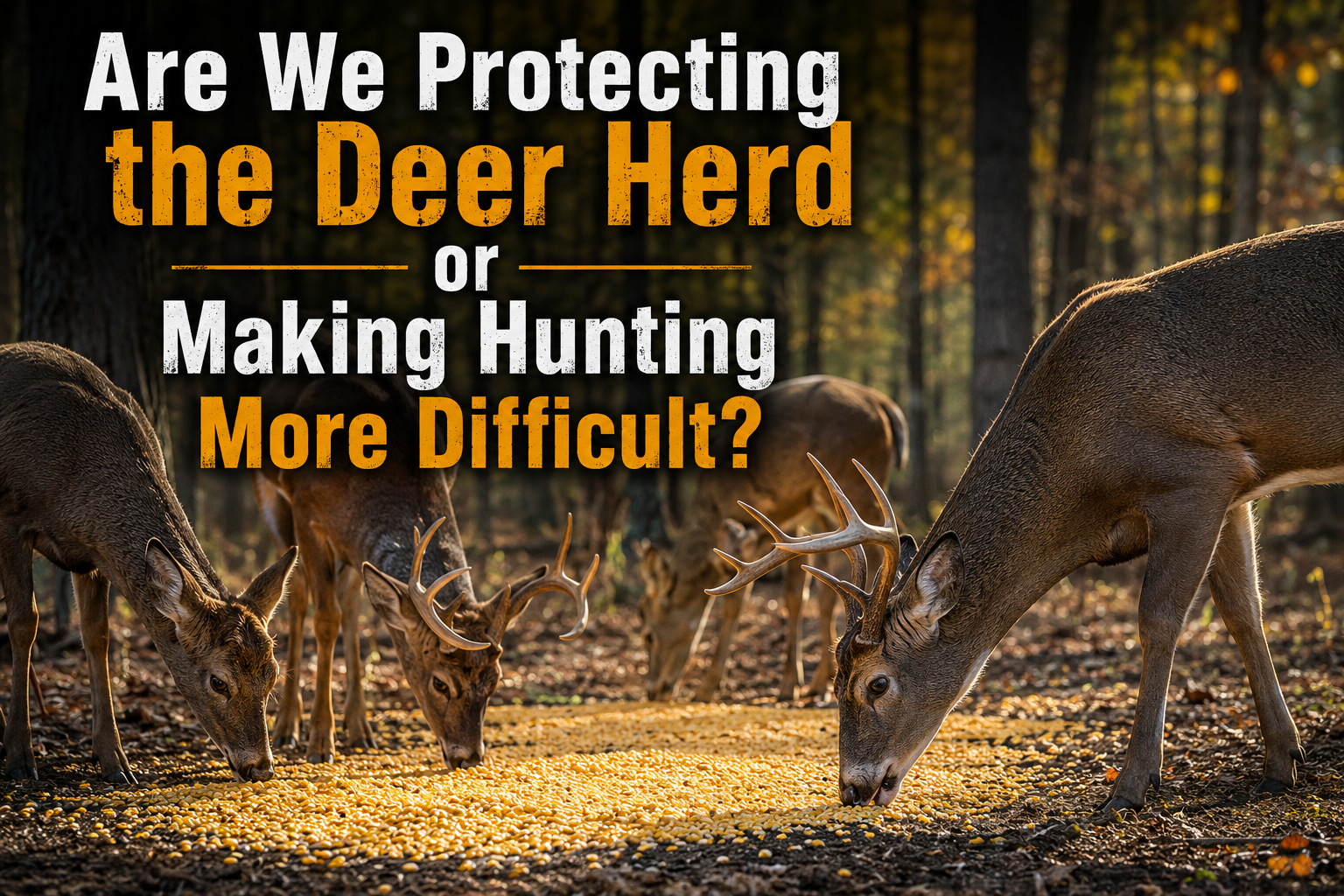
Are We Protecting the Deer Herd or Making Hunting More Difficult?
Delaware deer hunters are going to face some significant changes this season following the confirmation of Chronic Wasting Disease, or CWD, in two whitetail deer in central Sussex County. In response, the Delaware Department of Natural Resources and Environmental Control (DNREC) adopted emergency Delaware CWD regulations on August 17 designed to reduce activities that concentrate deer, limit the movement of potentially infectious material, and increase CWD surveillance during the upcoming hunting season.
As someone who has spent most of my life hunting deer on Delmarva and who now manages hunting properties here on Maryland’s Eastern Shore, I’ve been following this closely. It’s important to us because Sussex County isn’t hundreds of miles away. It’s right next door, and whatever happens with CWD in Delaware could eventually influence how Maryland manages the disease on our side of the state line.
I also think we need to be able to have an honest conversation about these regulations without immediately getting pushed into one of two camps. You don’t have to believe CWD is a hoax to question whether every regulation proposed to control it is necessary. At the same time, questioning regulations doesn’t require us to pretend CWD doesn’t exist.
CWD is a real disease. The more difficult question is whether the response is proportional to what we currently know about its presence in Delaware, whether these particular regulations will actually slow its spread, and what effect they could ultimately have on hunters.
Those are the questions I think we should be discussing.

What Do We Actually Know About CWD in Delaware?
Earlier this year, CWD was confirmed in two deer in central Sussex County. Because of the seriousness of the disease, DNREC worked with USDA Animal and Plant Health Inspection Wildlife Services and local landowners in July to conduct additional testing around the area where those deer were discovered.
The results of that follow-up testing are an important part of this story.
Wildlife officials collected and tested 100 additional deer adjacent to the locations of the two initial CWD findings. None of those 100 deer tested positive for CWD.
I consider that good news, and apparently DNREC does as well. DNREC Secretary Greg Patterson said that while the lack of additional positive samples was a relief, the agency believes this is exactly the time to act because CWD appears to have a very limited range in Delaware. DNREC’s position is that containing the disease now gives the state a better opportunity than waiting until it becomes more widespread.
I understand that reasoning. If you’re going to attempt to contain something, it makes sense to intervene while it appears limited rather than waiting until it is everywhere.
At the same time, I think hunters are justified in looking at those same numbers and asking questions. We have two confirmed cases followed by targeted testing of another 100 deer from the surrounding area with no additional positives. That doesn’t prove CWD isn’t present in other deer, nor does it tell us that the two positive animals were isolated cases. What it does tell us is that the focused sampling conducted so far did not reveal a larger cluster of infected deer.
To me, that argues very strongly for expanded testing and surveillance. Whether it also justifies immediately restricting certain hunting practices is where I think the discussion gets more complicated.
What Delaware’s New Emergency Regulations Actually Do
The emergency regulations establish a CWD Management Zone (CMZ) encompassing Delaware Wildlife Management Zones 14 and 16 in lower Sussex County, including DNREC’s Midlands Wildlife Area and Trap Pond State Park.
Within that management zone, hunters will no longer be permitted to use bait or feed to attract deer. Hunters who harvest deer within the CMZ during the November general firearm season, which runs November 13 through November 22, will also be required to check those deer at one of two designated stations. Those stations will be located at the Delaware Solid Waste Authority’s Jones Crossroads Landfill near Georgetown and the Gumboro Service Center.
There are also new requirements governing how harvested deer can be moved out of the CWD Management Zone to other parts of Delaware. The rehabilitation and relocation of rescued deer fawns originating within the Sussex County management zone will be prohibited as well.
One of the regulations goes considerably farther geographically. DNREC has imposed a statewide ban on natural urine-based deer lures, meaning that restriction applies to hunters throughout Delaware, not just hunters inside the CWD Management Zone.
DNREC will also expand CWD surveillance and make free testing available to hunters through self-service drop-off locations around the state. Before hunting season begins, the Division of Fish and Wildlife plans to distribute an addendum to the 2026 Delaware Hunting and Trapping Guide explaining CWD and the new regulations in greater detail.
These are emergency regulations, which is another important point. They are effective for 120 days and can potentially be extended for an additional 60 days. If DNREC wants to make these changes permanent, the agency will have to go through the normal regulatory process, including an opportunity for public comment.
That means what happens during the 2026 deer season could be extremely important.

The Baiting Ban Will Have a Real Impact on Hunters
Of all these changes, I suspect the prohibition on baiting and feeding deer within the CWD Management Zone will have the greatest immediate effect on the average deer hunter.
DNREC’s reasoning isn’t difficult to understand. A feeder or bait pile artificially concentrates deer in a small area. Deer eat from the same location, put their noses and mouths in the same feed, leave saliva and other bodily fluids behind, and return repeatedly. Because CWD prions can be shed by infected deer, reducing that concentration theoretically reduces opportunities for transmission.
There is a biological argument for doing it.
There is also a hunting reality that needs to be acknowledged.
Baiting has been a legal and established part of deer hunting for many hunters in Delaware. Some hunters have designed their entire hunting properties around feeders, bait locations, stand placement, access routes, and the deer movement those food sources create. Removing bait doesn’t simply mean those hunters leave a bag of corn at home this weekend. For some of them, it fundamentally changes how their property is hunted.
Experienced hunters with larger properties may adjust fairly easily. They can hunt natural food sources, bedding-to-feeding transitions, funnels, pinch points, field edges, and rut travel corridors. In some cases, removing bait may even make them better deer hunters.
But not every hunter has 300 acres and a dozen stand locations.
Think about the hunter who has permission on ten acres. Think about an older hunter who can’t walk a mile through a property anymore. Think about someone taking a 10-year-old hunting for the first time. Think about the landowner whose property doesn’t contain large agricultural fields or ideal natural food sources.
Baiting can provide those hunters with an opportunity to see deer and potentially harvest one.
Whether someone personally approves of hunting over bait isn’t really the issue. The important question is whether eliminating a previously legal hunting method provides enough measurable disease-management benefit to justify its impact on hunters.
I want to see that question answered with data.
Mandatory Check Stations Create Another Burden
DNREC needs samples. In fact, I believe widespread testing should be one of the state’s highest priorities right now because we need to determine whether those two positive deer represent an isolated pocket or the beginning of something more widespread.
Hunters can provide an enormous number of samples during deer season.
The problem is how we collect them.
Imagine hunting all afternoon and shooting a deer right before dark. You’ve got to recover it, get it out of the woods, load it into the truck, and perhaps you have your son or daughter with you. Normally you’d head home or take the deer to your processor.
If that deer was harvested within the CWD Management Zone during the November firearm season, you now have another mandatory stop at one of two designated check stations.
Depending upon where you hunt and where you live, that may mean additional driving and additional time at the end of an already long day.
Is that an impossible burden? Of course not.
But this is where wildlife agencies need to think about the cumulative effect of regulations rather than looking at each one individually. Hunters rarely stop hunting because of one regulation. Hunting becomes less attractive when we continue stacking inconvenience on top of inconvenience.
Carcass Transportation Is Going to Require More Education
There is a legitimate reason for carcass-transport restrictions. If an animal is infected, certain tissues can contain prions, and moving those materials long distances potentially creates another pathway for introducing infectious material into a new area.
But the practical effect is that hunters now have another set of rules they need to understand based upon exactly where the deer was killed and where they’re taking it.
That is why DNREC needs to make these regulations incredibly simple to understand. A hunter shouldn’t need to read several pages of regulations while standing next to a dead deer trying to figure out whether he can legally take it to his processor.
Clear maps, simple instructions, participating processor lists, disposal locations, and straightforward examples would go a long way toward getting hunters to cooperate voluntarily rather than making them feel like they’re walking through another regulatory minefield.
If wildlife agencies want hunter participation, regulations need to be understandable.
The Statewide Ban on Natural Deer Urine Raises Another Question
The agency’s concern is that CWD prions can be shed through bodily fluids, creating the possibility that natural urine products could introduce infectious material into the environment. Hunters who use scents can switch to synthetic products, so this regulation probably won’t dramatically change anyone’s season.
But it does raise a broader policy question.
If the known CWD detections are currently confined to a relatively small area of Sussex County, how far should emergency restrictions extend?
Perhaps DNREC has compelling evidence supporting a statewide prohibition. If so, explain that evidence to hunters.
That’s really what I’m asking for throughout this discussion: show us why each regulation is necessary and what it is expected to accomplish.
CWD Has Been Around Longer Than Many Hunters Realize
Part of the skepticism surrounding CWD comes from the fact that this isn’t some newly discovered disease.
CWD was first identified in captive deer in Colorado in the late 1960s and recognized as a distinct disease in the 1970s. In other words, CWD was known to science when I was a young hunter.
More than 50 years later, we’re still hunting deer throughout the United States.
That doesn’t mean CWD isn’t serious, and it doesn’t mean we should ignore it. We’ve learned a lot more about the disease over those decades. One particularly important thing we’ve learned is that an infected deer can carry and shed CWD prions before it develops the obvious outward symptoms hunters associate with a sick animal.
When I was growing up hunting, our approach to an obviously diseased deer was fairly simple. If an animal clearly looked sick or acted abnormally, you removed it from the herd when appropriate and reported it. There is still common sense in identifying and removing obviously sick animals, but we now know that approach alone isn’t sufficient for CWD because infected deer don’t necessarily look sick during the earlier stages of infection.
I’m willing to acknowledge that our management practices need to change as our knowledge improves.
What I don’t believe is that the existence of CWD should automatically end the discussion whenever a new regulation is proposed.
After more than five decades of CWD management around the country, hunters should be able to ask a very reasonable question: Which regulations have actually proven effective at reducing CWD prevalence or slowing its geographic spread?
If research shows that prohibiting baiting produces a meaningful reduction in transmission, show hunters the evidence. If carcass restrictions have demonstrably reduced human-assisted movement of CWD into new areas, explain that evidence. If natural urine products present a documented transmission risk significant enough to warrant a statewide ban, show us why.
Hunters are far more likely to cooperate when they understand the reason behind a regulation.

My Biggest Concern Is the Long-Term Effect on Hunters
This is where I think the discussion becomes bigger than CWD.
Wildlife managers need hunters.
Delaware needs hunters to control deer populations. Maryland needs hunters for the same reason. Hunters provide biological samples, report sick and dead animals, purchase licenses, support conservation through excise taxes, manage private habitat, and put more eyes in the woods than any wildlife agency could ever afford to employ.
In the case of CWD, hunters may actually become one of the most important tools DNREC has for determining how widespread the disease is.
That’s why we need to be extremely careful about creating a regulatory environment that discourages people from hunting.
Hunters already face plenty of obstacles. Hunting land is disappearing to development. Leases are becoming more expensive. Equipment isn’t getting cheaper. Access is increasingly difficult in many areas, and regulations are already complicated enough for someone entering the sport for the first time.
Now add CWD management zones, baiting restrictions, carcass-transport requirements, mandatory check stations, testing recommendations, and restrictions on products hunters have legally used for years.
Again, none of those things individually will end deer hunting.
The concern is their cumulative effect.
I’m probably going hunting regardless of how many pages are added to the regulation book. So are most of the people reading this article.
The person I’m concerned about is the hunter who hasn’t started yet.
We talk constantly about recruiting new hunters, but recruitment doesn’t mean much if we simultaneously make hunting more difficult to learn and participate in.
A father or mother trying to introduce a child to deer hunting shouldn’t feel like they need to take a class in wildlife disease regulations before heading to the woods.
Hunter recruitment matters.
Hunter retention matters just as much.
Is This a Slippery Slope for Hunting?
I know this is where the conversation can become controversial, but I think hunters are justified in asking the question.
What happens if these emergency regulations become permanent?
What happens the next time a positive deer is discovered outside the current CWD Management Zone? Does the zone expand? Does the baiting prohibition expand with it? At what point does a local restriction become a county-wide restriction or a statewide restriction?
What other regulations could follow?
I am not suggesting that DNREC has plans to eliminate deer hunting or that there is some hidden agenda behind these regulations. Wildlife agencies depend heavily upon hunters, and many wildlife biologists are hunters themselves.
But hunters should always pay attention when temporary restrictions are introduced because regulations have a tendency to be easier to enact than to remove.
That’s why the emergency nature of these rules is important. They are currently limited to 120 days, with the possibility of a 60-day extension. Making them permanent requires the normal regulatory process and public comment.
If that happens, Delaware hunters need to participate.
Don’t wait until regulations are finalized and then complain about them on Facebook.
Look at the data DNREC collects during the 2026 season. Read the proposed permanent regulations. Attend meetings if they’re offered. Submit public comments. Ask questions respectfully and demand evidence where appropriate.
Hunters need a seat at the table because we’re the people who will live with these decisions.
Could Regulations Unintentionally Benefit the Anti-Hunting Movement?
This question also needs some nuance.
I don’t think DNREC is trying to help anti-hunting organizations. I don’t believe wildlife biologists woke up one morning and decided to use CWD as an excuse to eliminate deer hunting.
That argument is too simplistic.
But regulations can have unintended consequences.
Organizations opposed to hunting ultimately benefit when fewer people hunt, when hunting opportunities disappear, when access becomes more difficult, and when participation declines.
If well-intentioned wildlife regulations contribute to any of those outcomes, then we need to consider those effects when evaluating the regulation.
That doesn’t mean we refuse every restriction because an anti-hunting organization might like the outcome. It means hunting participation needs to be part of the equation.
Protecting the deer herd while slowly driving away the people responsible for managing that herd doesn’t make much sense.
Hunters Should Be Viewed as Partners
This is one area where I believe DNREC has a tremendous opportunity.
Instead of viewing hunters primarily as people whose activities need to be regulated, use us as partners in CWD surveillance.
Think about the amount of information hunters collectively gather.
We have thousands of trail cameras operating throughout Delmarva. We observe deer throughout the year. We find dead animals. We manage habitat. We harvest deer and can provide tissue samples. We notice when deer disappear from an area or when something unusual starts happening.
That is an enormous wildlife-monitoring network, and most of it costs the state nothing.
DNREC’s decision to provide free CWD testing through self-service drop-off locations is something I strongly support. Make those locations convenient, encourage hunters to use them, and collect as many samples as possible.
If Delaware hunters provide hundreds or thousands of samples during the 2026 season, we’ll know far more about the situation than we do today.
That’s useful information whether you support the emergency regulations or oppose them.
Let the 2026 Deer Season Give Us More Answers
This is where I think the focus should be.
We currently know that two deer tested positive for CWD. We also know that targeted follow-up testing of 100 deer adjacent to those findings produced no additional positive results.
That’s the information available to us right now.
The upcoming hunting season provides an opportunity to dramatically expand that dataset.
If Delaware tests hundreds or thousands of hunter-harvested deer and additional positives begin appearing throughout Sussex County, that’s important. If positives begin appearing outside the current management zone, that’s even more important and may justify a different response.
On the other hand, if extensive testing continues to produce very few or no additional positive deer, that information matters too.
Either way, the data should drive what happens next.
If DNREC eventually proposes making these emergency regulations permanent, I would like to see the agency provide hunters with a clear report explaining how many deer were tested, how many were positive, where those animals were harvested, whether prevalence appears to be increasing, and what evidence supports continuing each individual restriction.
If a regulation works, keep it as long as it’s necessary.
If it doesn’t accomplish what it was intended to accomplish, get rid of it.
That’s how adaptive wildlife management should work.
Maryland Hunters Need to Pay Attention to What Happens in Delaware
This issue isn’t limited to Delaware.
Sussex County borders Maryland’s Eastern Shore, and deer don’t recognize state lines. What Delaware learns during this hunting season could influence how Maryland approaches CWD if positive deer eventually turn up on our side of the border.
Could Maryland eventually establish a CWD Management Zone on the Eastern Shore? Could baiting regulations change? Could Maryland impose carcass-transport restrictions or prohibit natural deer urine products?
I don’t know, and I’m not suggesting those changes are coming.
But Maryland hunters should be watching what happens in Delaware because Delaware could become the case study for how CWD is managed on Delmarva.
That’s another reason I want to see this done carefully.
If Delaware’s approach works, we’ll have something to learn from.
If certain restrictions have little measurable effect, we should learn from that too.

CWD Is Real, but So Is the Impact of Regulation
That’s probably the simplest way I can explain where I stand on this issue.
I don’t think hunters need to choose between believing CWD is a legitimate wildlife disease and questioning how government agencies respond to it.
Both can be true.
We can support CWD testing while questioning a baiting prohibition. We can understand the logic behind carcass-transport restrictions while asking whether those restrictions are practical. We can support wildlife biologists gathering information while demanding that temporary emergency regulations don’t automatically become permanent.
Most importantly, we can insist that hunters remain part of the discussion.
The goal should be protecting healthy deer populations and preserving a strong hunting community capable of managing those populations for generations to come.
One shouldn’t have to come at the expense of the other.
Final Thoughts
I’ve been hunting long enough to watch wildlife management change dramatically. Some of those changes have unquestionably made hunting and conservation better. We’ve learned more about deer biology, habitat management, disease, genetics, nutrition, and population management than hunters from previous generations could have imagined.
As our knowledge changes, our management practices sometimes need to change too.
But change should be based upon evidence.
Two CWD-positive deer in Sussex County deserve our attention. The fact that targeted sampling of another 100 deer surrounding those findings produced zero additional positives deserves our attention as well.
For me, that means Delaware should continue testing aggressively. Hunters should participate in that testing. Sick or abnormal deer should be reported. We should learn everything we possibly can about where CWD exists on Delmarva and how prevalent it actually is.
What I’m not ready to do is assume that every restriction imposed in the name of CWD should automatically become part of deer hunting forever.
Let’s see what the 2026 season tells us.
Let’s look at the data.
Let’s listen to the wildlife biologists, but let’s listen to hunters and landowners too.
And before any of these emergency regulations become permanent, let’s make sure they are actually accomplishing enough to justify their impact on the people who hunt.
Because protecting our deer herd matters.
Protecting the future of hunting matters too.
About the Author

David Fletcher is the owner of Nanticoke Outfitters on Maryland’s Lower Eastern Shore. David has spent decades hunting deer and managing private hunting properties throughout Delmarva. Through Nanticoke Outfitters Land Management Services, he works with landowners to improve wildlife habitat, hunting strategy, property access, stand placement, and long-term deer management.
Learn more about Nanticoke Outfitters and our land management services at NanticokeOutfitters.com.