
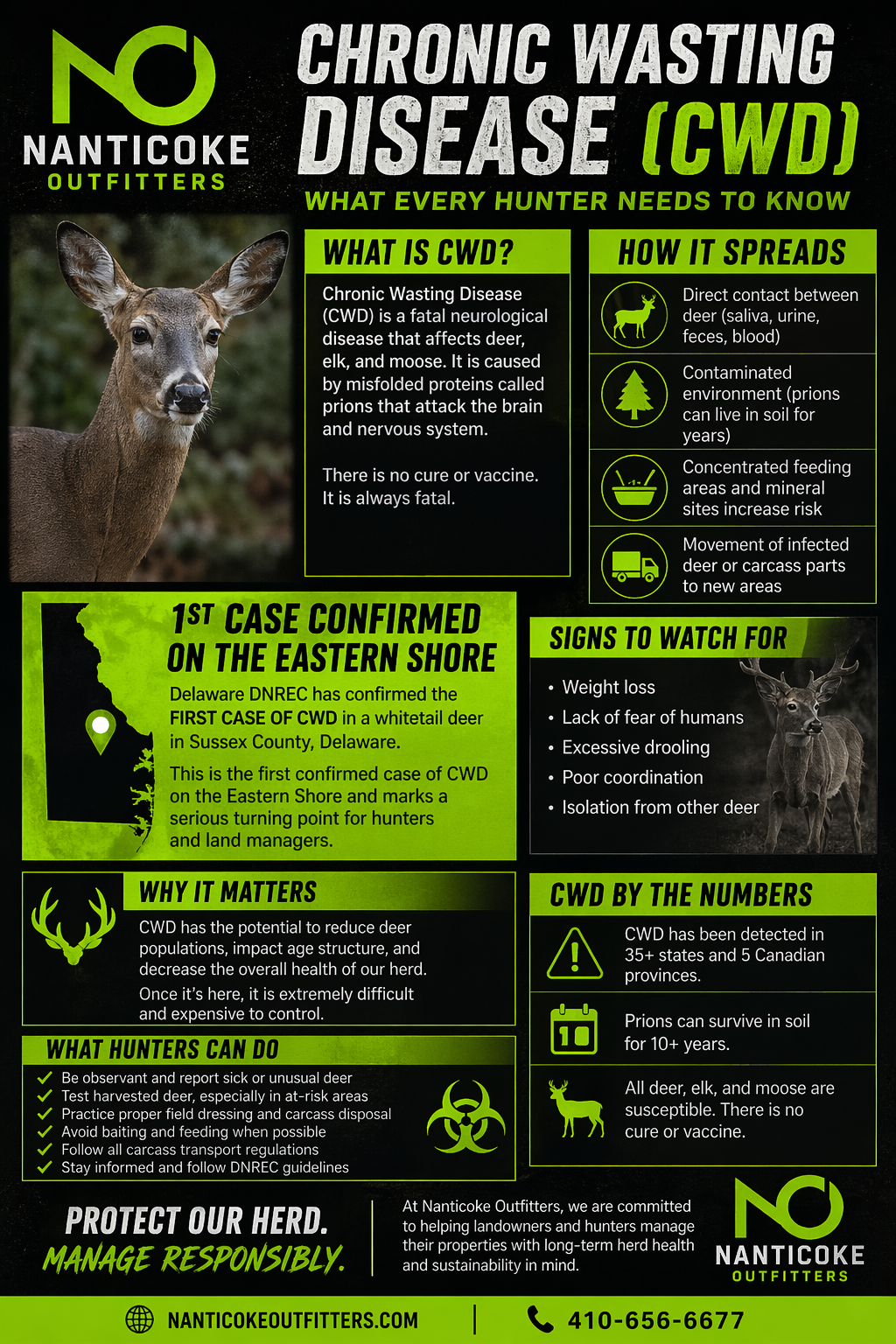
CWD Delaware. Two words that I hoped to never hear together. Delaware DNREC has officially confirmed its first case of Chronic Wasting Disease (CWD) in a whitetail deer. For years, we’ve watched it creep across the country and hoped it would stay far enough away not to impact our deer herd here on Delmarva. That’s no longer the case.
But honestly folks, this isn’t something to panic over. It’s something to be aware of because CWD is real and really can have an impact on your herd. I don’t see us running out and changing how we hunt but you should think about your actions and if CWD i going to impact some of the decisions you make as a hunter, conservationist, and land manager.
If you hunt anywhere on the Eastern Shore, this is something you need to pay attention to. Here on the Eastern Shore of Maryland, we always seemed to feel a little safe from CWD because according to our Department of Natural Resources, all of the confirmed CWD cases have been on the Western Shore with many out in Western MD. The disease was detected for the first time in Maryland from a deer taken by a hunter in November 2010, in Allegany County. To date, 285 infected deer have been documented in the state.
Now the question becomes—what does this actually mean for us as hunters, land managers, and conservationists? And more importantly, what should we be doing right now to protect the deer we’ve worked so hard to manage?
I want to break this down in a way that makes sense and gives you real, practical steps you can take starting today.
What is CWD (Chronic Wasting Disease)?
Chronic Wasting Disease is a fatal neurological disease that affects deer, similar to mad cow disease. It’s caused by misfolded proteins called prions, and once it’s in an area, it does not go away.
The disease spreads through bodily fluids like saliva, urine, and feces, and it can also persist in the soil for years. That’s what makes it especially dangerous. You’re not just dealing with infected deer—you’re dealing with a contaminated environment.
Infected deer often show symptoms like extreme weight loss, lack of fear of humans, excessive drooling, and erratic behavior. But here’s the problem—many deer can carry and spread CWD long before they ever show visible signs.
That’s why this is something we have to take seriously right now, not later.

Why This CWD Delaware Case Matters to Us
This isn’t just a “Delaware problem.”
If you’re hunting in Dorchester, Wicomico, Somerset, or Worcester County, this hits close to home. Deer don’t recognize state lines, and neither does CWD.
The Eastern Shore is one connected ecosystem. The same deer we’re managing on our properties are moving, especially young bucks. Once CWD enters a region, it typically spreads slowly but steadily.
From a management standpoint, this changes things. From a hunting standpoint, it should change how we think about biosecurity and responsibility. As you can see in the map below, CWD cases have only been on the western shore. This will no longer be the case.

What This Means for Your Deer Herd
If you care about growing, managing, and hunting mature whitetails, CWD is one of the biggest long-term threats we face.
It has the potential to reduce population numbers over time, impact age structure, and change deer behavior. In heavily infected areas, you can see fewer mature bucks and a noticeable decline in overall herd health.
But one of the biggest impacts is something most hunters don’t think about—how it affects management strategies.
You can’t manage deer the same way in a CWD zone as you can in a clean area. The margin for error gets smaller, and the importance of discipline gets higher.
What Hunters Should Be Doing Right Now
This is where we can actually make a difference.
First, we need to take deer health and observation more seriously than ever. If you see a deer that looks sick, acts strange, or shows no fear, report it. Don’t ignore it and don’t assume someone else will handle it.
Second, be mindful of how you handle harvested deer. Proper field dressing, minimizing contamination, and following all state guidelines on transporting carcasses is critical. Moving infected material from one area to another is one of the fastest ways this disease spreads.
Third, think about your feeding and baiting practices. Concentrating deer unnaturally increases nose-to-nose contact, which increases the likelihood of disease transmission. Even if legal in your area, it’s something worth seriously reconsidering.

Fourth, testing needs to become part of the routine. If you harvest a deer, especially in areas closer to the confirmed case, get it tested. This isn’t just about your deer—it’s about protecting the entire herd.
What We’re Doing at Nanticoke Outfitters
This is something we’re taking seriously across all of our properties.
We already run low-pressure hunting strategies, which naturally helps reduce stress and unnatural deer movement. We’re going to continue focusing on limited stand pressure, controlled access, and disciplined harvest strategies.
We’re also paying closer attention to deer behavior on camera. Trail camera data becomes even more important in a situation like this because it allows us to monitor patterns and identify anything unusual early.

If CWD is confirmed in your area, avoid using gravity feeders. Also avoid placing feed on the ground.
Another thing we’re emphasizing is communication with our hunters. Everyone who steps on our properties needs to understand the importance of handling deer properly and following best practices.
Good management isn’t optional anymore—it’s required.
The Role of Hunters in Slowing the Spread
This is where I’m going to be direct.
Hunters are the front line when it comes to CWD. Agencies can set regulations, but they can’t control what happens on every property. That responsibility falls on us.
If we ignore it, cut corners, or assume it’s not our problem yet, we’re only speeding up the spread.
If we stay disciplined, follow guidelines, and make smart decisions, we can slow it down and protect what we’ve built.
This is no different than managing hunting pressure or improving habitat. It’s just another layer of responsibility that comes with being serious about deer hunting.
What Happens Next?
Typically, once a case is confirmed, you’ll start to see increased testing, possible regulation changes, and more attention from wildlife agencies.
That could include things like carcass transport restrictions, mandatory testing zones, or changes in feeding and baiting laws.
The key is to stay informed and be ready to adapt. The hunters who adjust early are the ones who will continue to be successful long-term.

Final Thoughts on CWD Delaware
First and foremost PLEASE REMEMBER that this isn’t something to panic about, but it is something to take seriously.
We’ve spent years building strong deer populations here on the Eastern Shore. The last thing we want to do is ignore a problem that has already impacted other parts of the country.
The good news is we still have time to do this the right way.
Pay attention. Stay disciplined. Make smart decisions.
That’s how we protect the future of hunting.
About the Author
Captain David Fletcher is the owner of Nanticoke Outfitters, offering guided Sika deer, whitetail deer, and waterfowl hunts on Maryland’s Eastern Shore. With decades of experience managing private land and hunting mature deer, he focuses on low-pressure strategies and long-term herd health to deliver high-quality hunting experiences.
